
- Page d'accueil
- Age
- Culture
- Maker
- Matière
- Pays D'origine
- Type
- Bois (9)
- Bouddhisme (14)
- Bronze (123)
- Christianisme (53)
- Cuivre (18)
- Figurine (9)
- Figurine / Statue (6)
- Figurine, Statue (210)
- God Horus (9)
- Goddess Hathor (4)
- Goddess Isis (6)
- Jade (6)
- Netsuke (7)
- Pendule à Poser (15)
- Sculpture (615)
- Sculpture, Statue (10)
- Statue (112)
- Statue Sculpture (8)
- Statue, Sculpture (2327)
- Statues (11)
- ... (1267)
Anthonin Mercié. Bronze ancien Barbedienne.''David et Goliath'' 71 cm

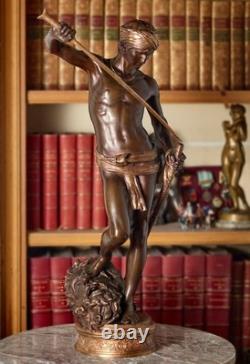
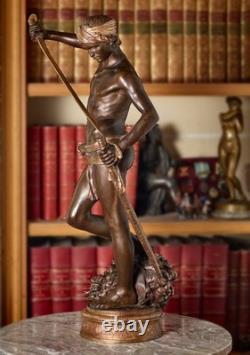
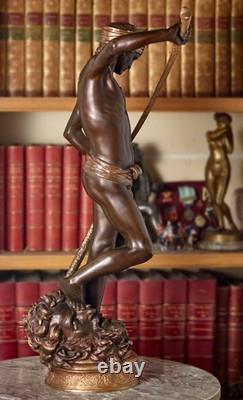
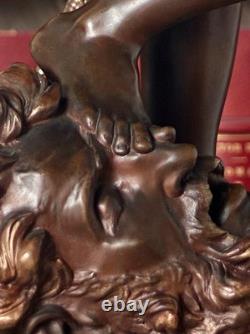
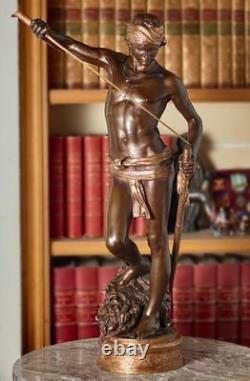


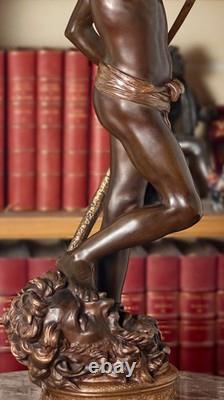


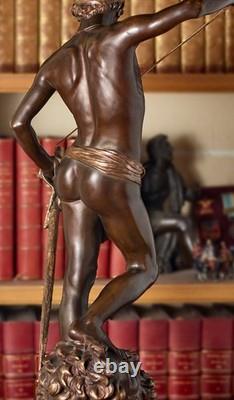

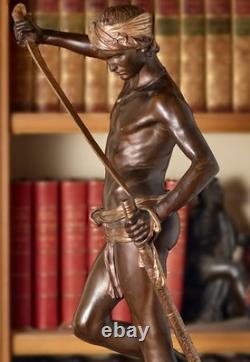
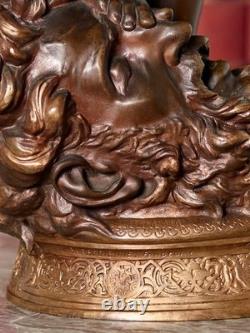
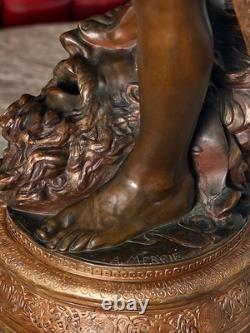
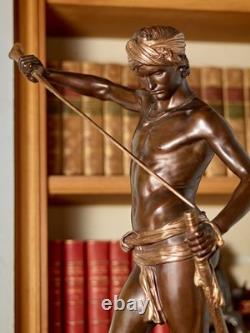
Grande Sculpture en bronze d'Anthonin Mercié (1845 - 1916) ,''David''. Reproduit dans Kjelberg, Les bronzes du XIXe siècle, édition de l'Amateur, p. Modèle iconique fait d'un mélange de grâce qui tranche avec la dureté du sujet. Bronze double patines, médaille et doré. Lorsqu'il compose son David, en 1869, Mercié est pensionnaire à l'Académie de France à Rome. Son ambition est de renouveler la représentation de cet épisode biblique relatant. La victoire en duel du jeune berger sur le géant Goliath, tout en se plaçant dans la filiation. Des grands bronziers de la Renaissance florentine, notamment Donatello et Verrocchio. Présenté au Salon après la guerre de 1870, le David remporte un grand succès en raison de l'élégance.
De sa pose et de la fermeté de son modelé, mais aussi comme symbole d'espoir. D'une revanche future de la France sur la Prusse.
Antonin Mercié exécute le plâtre à Rome, où il finit sa formation. La statue lui vaut la Légion d'honneur. L'oeuvre est commandée en bronze par l'Etat en 1872, puis placé au musée du Luxembourg dès 1874. La statue devient l'une des images les plus diffusées dans les journaux illustrés. Et connaît un tel succès qu'elle est édité en petite taille, et en six dimensions différentes par le fondeur Barbedienne. La statue de David est conservée au Musée d'Orsay à Paris, un autre exemplaire se trouve. Au Musée des Augustins à Toulouse.Signature de l'Artiste : A. Fonte Barbedienne d'exception avec inscription :'' F.
Vous aurez ce que vous voyez en photos. Anthonin Mercié (1845 - 1916) ,''David''. An iconic model combining grace that contrasts with the hardness of the subject. Bronze with double patina, chocolate and gilt tones. When he composed his David in 1869, Mercié was a resident artist at the French Academy in Rome.Was to renew the representation of this biblical episode recounting the young shepherd's victory in single combat. Over the giant Goliath, while placing himself in the lineage of the great Florentine Renaissance bronziers. Presented at the Salon after the Franco-Prussian War of 1870, David achieved great success thanks.
To the elegance of its pose and the firmness of its modeling, but also as a symbol. Of hope for a future French revanche against Prussia. A similar example is exhibited at the Musée d'Orsay in Paris.
Exceptional Barbedienne cast, inscribed: F. You'll get what you see.